Cities Are Heard Before They Are Mapped
A street is an acoustic pattern as much as a route.
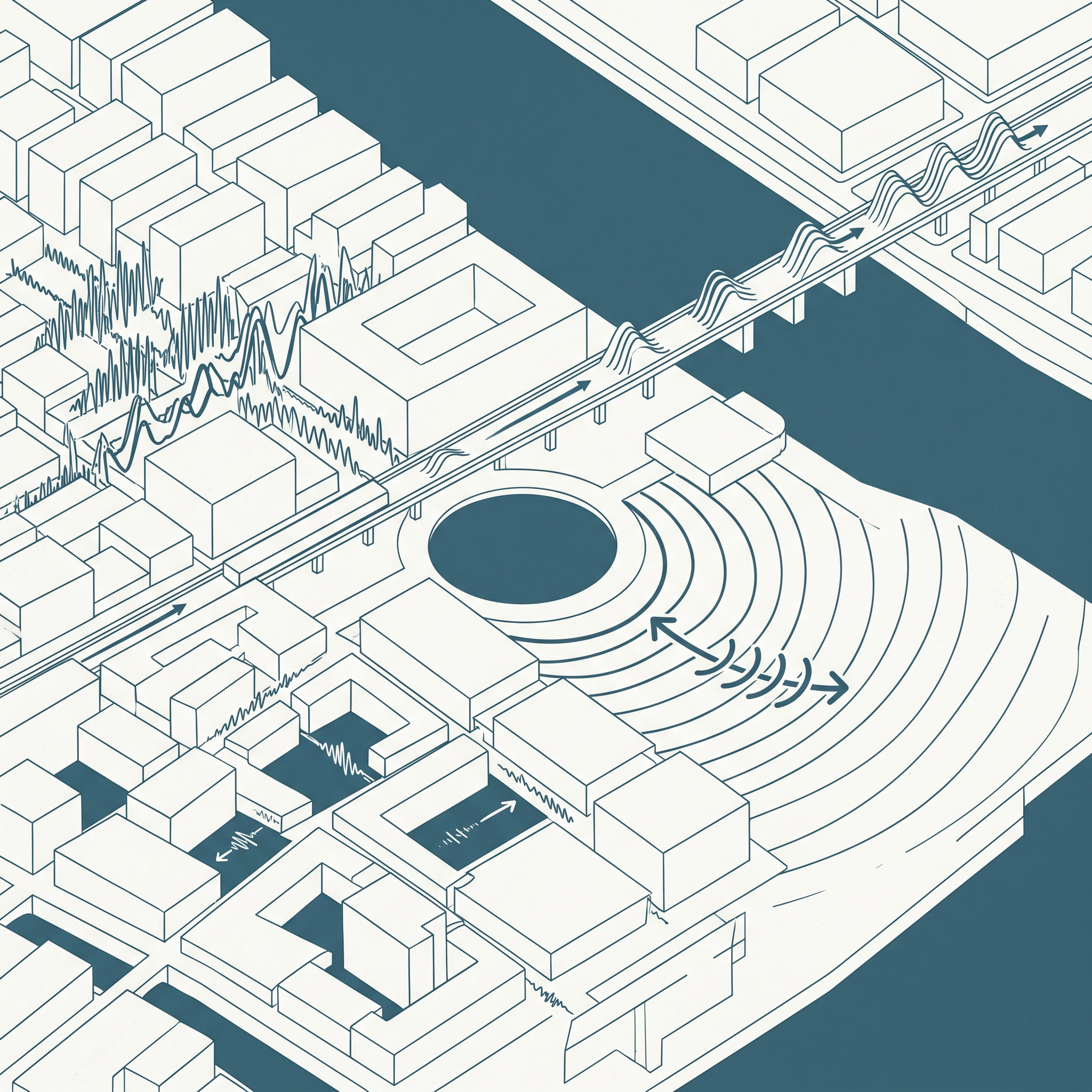
A city is often described through landmarks, roads, and districts. But we also know cities by sound. The steady pulse of traffic, the sudden hush of a side street, the echo under a bridge, the layered voices at a market, the distant train announcing itself before you see it. These sounds are not background noise in the casual sense. They are part of how urban life organizes itself.
Sound gives a city rhythm. It signals where movement gathers, where it slows, where it spills into a wider space. A narrow alley can feel private because footsteps travel differently there. A plaza can feel public because every sound seems to return with company. Even without looking, we can often tell whether a place is dense, open, sheltered, or exposed.
This matters because cities are experienced in motion. We do not stand outside them and inspect them like models. We pass through them, listening as we go. Sound helps us orient ourselves and also helps us feel oriented socially: who has space to speak, who has to raise a voice, which areas invite pause and which ones push us along.
When we think about architecture as sound, the city stops being only a visual map. It becomes an environment of cues, pauses, and thresholds. Listening is one of the ways we learn where we are.